





Industrial Wooden Packaging Market Trends 2025: A Practical Guide for Pharma, Engineering and Chemical Companies
Understand how wooden pallets, crates and boxes are evolving, and what this means for your industrial supply chain.
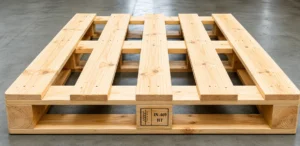
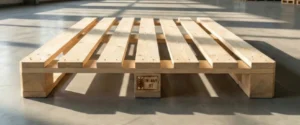
Export‑ready wooden pallets and crates used in industrial supply chains.
Introduction
Demand for industrial wooden packaging is steadily increasing in India and globally, especially in pharmaceutical, engineering and chemical sectors.
Buyers now evaluate packaging not only on cost but also on sustainability, compliance and export readiness, where high‑quality wooden pallets, crates and boxes play an important role.
Where Industrial Wooden Packaging Is Commonly Used?
Industrial Wooden Packaging is common in sectors like engineering, pharmaceuticals, automotive, construction and chemicals that move high‑value or bulky goods.
These industries rely on custom wooden pallets and crates to meet industry standards, prevent damage and keep products stable throughout storage, handling and export shipments. In some operations, accessories such as pallet collars are also used to improve stacking safety and flexibility.
Why Demand for Wooden Packaging Is Growing
Global market studies indicate that the wooden packaging segment is expected to grow at a steady mid single‑digit rate over the next few years, supported by rising industrial production and exports.
- Manufacturers are moving more goods across longer distances and multiple modes of transport.
- Export volumes are increasing, which drives the need for standardized, strong transport packaging. [file:1][web:14]
- Companies prefer solutions that can be reused, repaired and recycled instead of single‑use options.

A well‑organized pallet and crate layout supports efficient loading and unloading.
Sustainability: Wooden vs Plastic Packaging
Due to environmental regulations and customer expectations, companies prefer packaging that is recyclable, biodegradable and compatible with circular economy principles, where wood is a natural choice.
Wooden pallets can be repaired, reused many times and finally recovered for energy or other applications, which helps reduce overall waste in the supply chain.
Research comparing wooden and plastic pallets shows that, when wooden pallets are properly reused and recovered at end‑of‑life, their overall environmental impact can be lower than that of virgin plastic pallets.
ISPM‑15 and Export‑Grade Wooden Pallets
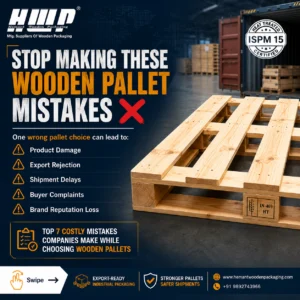
For international shipments, ISPM‑15 compliant heat‑treated wooden pallets and crates have become essential because they meet global phytosanitary requirements.
- Heat treatment raises the core temperature of the wood for a defined time to eliminate pests.
- After treatment, pallets and crates receive an IPPC/ISPM‑15 stamp that customs authorities recognise.
- Using certified pallets helps reduce the risk of delays, quarantine or rejection at destination ports.
ISPM‑15 stamped pallets are mandatory for most export shipments.
Sector‑Wise Opportunities: Pharma, Engineering, Chemicals
Different industries use industrial wooden packaging in different ways, but all require safety, consistency and reliability.
- Pharmaceuticals: High‑value, fragile and temperature‑sensitive products need stable pallets and crates that support clean handling and clear traceability.
- Engineering and capital goods: Heavy, odd‑size machinery and components move in custom wooden crates, saddles and skids designed for lifting, stacking and sea‑worthy packing.
- Chemicals: Drums, IBCs and hazardous materials rely on load‑bearing wooden pallets and dunnage that support safe storage and transport.
Custom wooden crates protect heavy equipment during long‑distance transport.
Material Trends: Softwood, Hardwood and Engineered Wood
Softwood pallets are widely used in industrial logistics because they are relatively lightweight, cost‑effective and easily available for high‑volume operations.
Engineered wood products such as plywood and composite blocks are gaining traction where better dimensional stability, higher strength‑to‑weight ratio and improved pest resistance are required.
E‑Commerce, Automation and Traceability
With the growth of e‑commerce and organised retail, businesses focus more on returnable packaging, standard pallet sizes and damage‑free deliveries, where sturdy wooden pallets and boxes are widely used.
Advanced supply chains are beginning to integrate RFID tags, barcodes and sensor‑based tracking with wooden pallets to improve real‑time visibility, inventory accuracy and chain‑of‑custody documentation.
What This Means for Indian Industries
In markets like India, expansion in manufacturing, exports and infrastructure projects supports a positive long‑term outlook for industrial wooden packaging.
Companies that combine sustainability, export compliance, custom design and reliable service are well positioned to grow in pharma, engineering, automotive, chemical and construction segments.
How Hemant Wooden Packaging Can Help
A specialist provider like Hemant Wooden Packaging designs customised pallets, crates, boxes, saddles and dunnage that are optimised for the specific load, size and handling needs of pharma, engineering and chemical clients.
The company supports export‑ready, safe and cost‑efficient industrial wooden packaging through ISPM‑15 heat treatment, fumigation, design assistance and reliable on‑time delivery.
Talk to our packaging expert